Introduction:
This document provides a high-level overview of the integration architecture and workflow between SupportLogic UI, Background Services, API Data Access layer, UWF (Workflow Orchestration Service), Pipe DB (metadata repository), and external Customer CRM systems.
The objective of this solution is to enable controlled, scalable, and configurable interactions between SupportLogic workflows and multiple CRM platforms through CRM-specific REST APIs for creating and updating records.
High-Level Architecture
Architecture Diagram
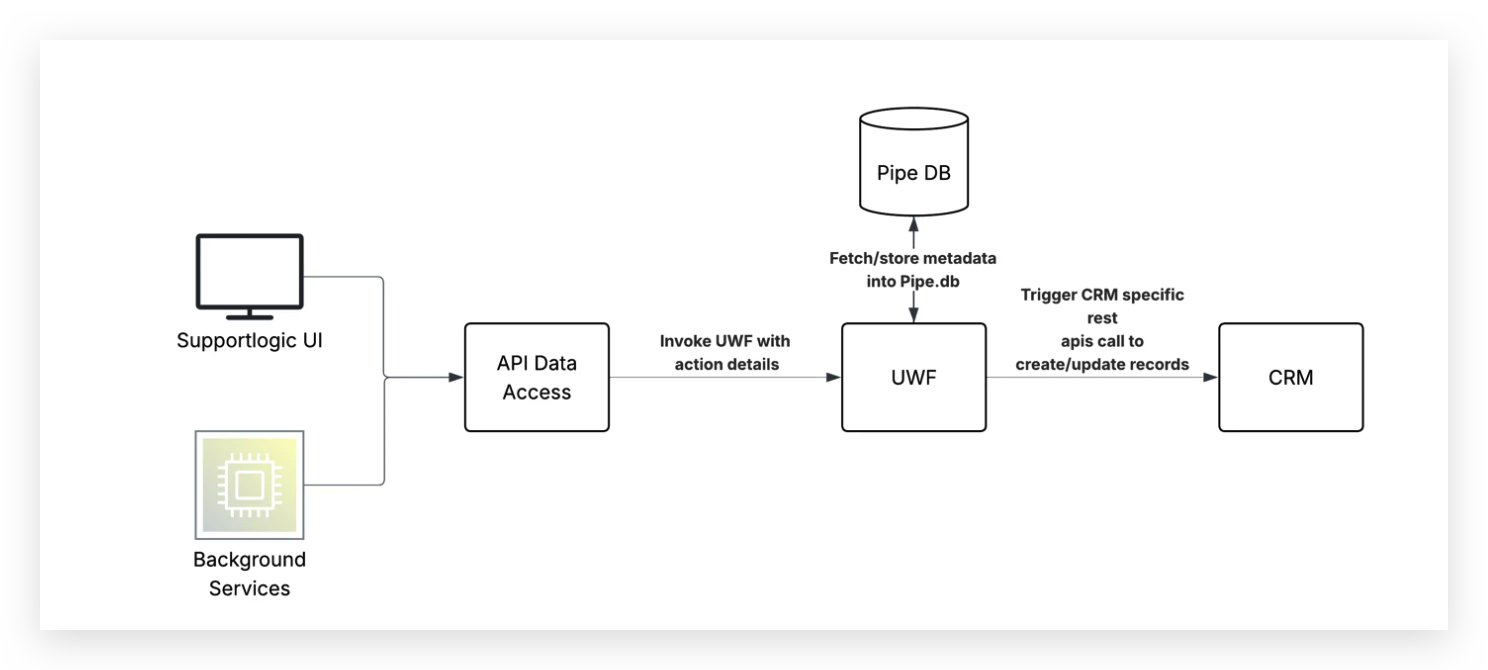
Architecture Components
Component | Description |
|---|---|
SupportLogic UI | User-facing interface used by agents or administrators to trigger business actions and workflows. |
Background Services | Automated backend services or scheduled jobs that initiate workflow actions asynchronously. |
API Data Access | Centralized service layer responsible for validating requests, preparing action payloads, and invoking UWF workflows. |
UWF (Workflow Orchestration Service) | Core orchestration layer responsible for processing workflow actions, retrieving metadata, applying business rules, and invoking CRM APIs. |
Pipe DB | Metadata repository storing workflow configurations, field mappings, integration metadata, and runtime configuration details. |
CRM Systems | External CRM platforms (e.g., Salesforce, Zendesk, ServiceNow, etc.) where UWF performs create, update, and other record operations via REST APIs. |
End-to-End Workflow
Step-by-Step Flow
- A workflow request is initiated from either:
- SupportLogic UI
- Background Services
- The request is routed to the API Data Access layer.
- API Data Access validates the request and prepares the action payload required for workflow execution.
- API Data Access invokes UWF with the processed payload.
- UWF retrieves workflow metadata and configuration details from Pipe DB.
- Based on metadata, UWF determines:
- Target CRM system
- Required API mappings
- Workflow rules and conditions
- UWF performs the following operations:
- Determines required CRM action
- Dynamically maps fields
- Identifies CRM-specific API endpoints
- Constructs CRM-specific REST API requests
- UWF invokes CRM APIs to perform operations such as:
- Create records
- Update records
- Add comments or activity logs
- Perform other configured CRM actions
- The CRM processes the request and returns a response.
- UWF handles:
- Response processing
- Logging
- Error handling
- Final execution status is returned to the originating system.
Key Design Principles
Metadata-Driven Architecture
The integration is fully driven by metadata stored in Pipe DB, enabling:
- Dynamic field mappings
- Configurable workflows
- Reduced hardcoded logic
- Faster onboarding of new use cases
Loose Coupling
Each component has a clearly defined responsibility:
- API Data Access → Request validation and preparation
- UWF → Workflow orchestration and execution
- Pipe DB → Configuration and metadata management
This improves maintainability, scalability, and flexibility.
Extensibility
The architecture supports future enhancements including:
- Additional CRM platform integrations
- New workflow actions
- Event-driven processing capabilities
Integration Approach
CRM Integration
UWF interacts with CRM systems using CRM-specific REST APIs.
Supported operations include:
- Create records
- Update records
- Change ownership or assignment
- Update priority or status
- Add comments or notes
Authentication
Authentication methods vary depending on CRM platform and may include:
- OAuth 2.0
- API Tokens
- Access Tokens
- Refresh Tokens
- CRM-specific authentication mechanisms
Error Handling and Reliability
The system ensures enterprise-grade reliability through:
- Centralized logging and monitoring
- API response validation
- Metadata validation
- Graceful error propagation
- Timeout handling for external API calls
Conclusion
This architecture provides a scalable, configurable, and maintainable framework for orchestrating CRM operations through UWF.
The metadata-driven design enables rapid onboarding of new CRM platforms and workflows while maintaining loose coupling, operational reliability, and extensibility.
Was this article helpful?
That’s Great!
Thank you for your feedback
Sorry! We couldn't be helpful
Thank you for your feedback
Feedback sent
We appreciate your effort and will try to fix the article